Best Heated Propagator for Chilli Seeds UK — Our Recommendations
If you are serious about growing chillies in the UK, a heated propagator is one of the most impactful pieces of equipment you can buy. More than grow lights, more than any particular compost or feed – getting your seeds into consistent warmth from the moment they’re sown is what separates reliable germination from the frustrating lottery of a cold windowsill in January.
We’ve been germinating chilli seeds for over 20 years and have tried everything from windowsills to warm airing cupboards, reptile heat mats right up to proper thermostatically controlled propagators. This guide covers every option, what to look for, and our honest recommendations at every budget. We will help you find the best heated propagator for chilli seeds within your budget.
This post contains affiliate links — if you purchase through our links we may earn a small commission at no extra cost to you. See our affiliate disclosure for details.
Do You Need a Heated Propagator for Chilli Seeds?
Honestly — yes, if you’re sowing before April or growing any hot varieties (i.e. not cayenne/apache).
Chilli seeds need soil temperatures of 25-28°C to germinate reliably. Fast-maturing Capsicum annuum varieties like Cayenne and Jalapeño will germinate in 2-7 days at that temperature. Slow Capsicum chinense varieties including Habanero, Scotch Bonnet, Naga and Carolina Reaper need 28-30°C and can take 2-6 weeks even at optimum temperature. Without supplemental heat, UK room temperatures in January and February — typically 18-20°C — mean slow, unreliable germination or no germination at all.
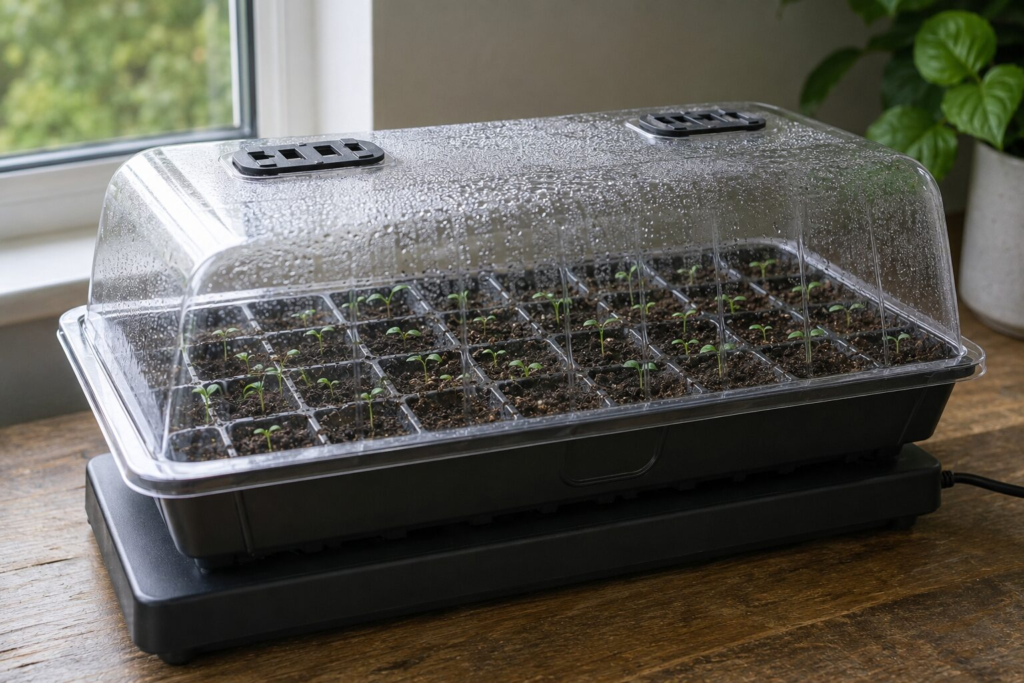
Because of our cooler temperatures, plants like chilli and bell peppers need a long growing season to give them time to grow, flower, produce fruit and for the fruit to ripen. Germinating them indoors in a heated propagator early in the year ensures they get the long growing season they need.
The good news is that modern heated propagators are cheap to run. Most only use around 15-25W of power meaning they cost pennies to run per day. The only real part that can fail is the heating element so a good quality unit should last for years.
For our full guide on temperatures and germination times by variety see our chilli seed germination temperature guide.
What to Look For in a Heated Propagator for Chilli Seeds
Before sharing our recommendations, here’s what actually matters. Below are the key features to consider and look out for when choosing the right propagator for you.
Thermostat vs no thermostat
This is the most important decision and definitely worth considering. A non-thermostat propagator provides a fixed amount of bottom heat (typically raising the compost temperature by 5-15°C above ambient). In a warm room this is usually sufficient for annuum varieties. The problem is that ambient temperature in different rooms in your house often varies significantly. When temperatures drop significantly overnight, your compost temperature will drop with it as the propagator only adds the same additional heat as it does during the day.
For chinense varieties that need a consistent 28-30°C, a thermostatically controlled unit is a significant advantage. As night time temperatures drop the thermostat will kick in and add more heat to compensate for the ambient temperature drop.
If you’re germinating on a warm kitchen windowsill and growing mainly jalapeños, cayennes and other fast growing annuum varieties, a budget non-thermostat propagator is perfectly adequate. If you’re germinating in a greenhouse or conservatory, or growing habaneros, nagas and other superhots our recommendation is to spend a bit more and get one with a thermostat.
Temperature range
It is worth checking that the propagator can actually reach the temperatures you need. A basic propagator is usually pre-set to 15-21°C, the optimum temperature for germination of many plants. More sophisticated models have a soil thermometer and a thermostat to give you greater control depending on what you’re growing.
For superhot chilli varieties you need to hit 28-30°C in the compost — not just 25°C at the heating element. The Vitopod’s digital thermostat has a range of 5°C to 30°C, meaning you can set the temperature up to 30°C, ideal for exotics. If your chosen propagator can only reach 25°C, superhot seeds may germinate slowly or not at all.
Size and capacity
Think about how many seeds you’re germinating simultaneously. If you grow 5-6 varieties with 3-4 seeds each, you need a propagator that fits at least 20-25 individual pots or cells. Many windowsill propagators are deceptively small so always check the internal dimensions before buying.
Lid height
Often overlooked but genuinely important. Once your seeds germinate you need enough headroom for seedlings to develop (in the heated environment the propagator provides) before they need moving on. If you are sowing different varieties next to each other they may germinate and grow at different times.
A propagator with a lid height of only 5-6cm will need the lid removing within days of germination, losing the heat benefit. Look for at least 10-15cm of internal height (ideally more), or choose a propagator with adjustable height extensions to give the best flexibility.
Even heat distribution
Some cheaper propagators often have hot spots directly above the heating element and cold spots at the edges. A good propagator heats evenly across the entire surface (no cold spots at the edges) giving consistent germination results across all cells.
Pro tip: One way you can improve the heat distribution of a cheap propagator is to add a layer of sand (3-7cm deep) into the bottom of the tray above the heating elements. Sand adds thermal mass under your seed tray which will help to stabilise and even out the heat transfer.
Our Propagator Recommendations
Budget Option: Garland Trio Top Electric Heated Propagator
Best for: Beginners, growing mainly fast growing annuum varieties (jalapeño, cayenne, Hungarian hot wax), germinating on a warm kitchen windowsill.
Price: approximately £25-£40 on Amazon UK
The Garland Trio Top is the propagator we recommend to anyone starting out and still use ourselves for early annuum varieties. It maintains a consistent temperature that generally gives a good germination rate and fits perfectly onto a kitchen windowsill or potting bench. It has three individual seed trays, each with airflow control meaning you can easily sow three different varieties simultaneously.
Despite having three cells it has a compact design being 76cm long and just 18.5cm wide. The 13W carbon fibre heating element raises compost temperature by around 8°C above ambient. In a warm room at 18-20°C this typically gives you 26-28°C in the compost – ideal for jalapeños, cayennes and most annuum varieties.
The honest limitations: There’s no thermostat, so if ambient temperature drops below 15°C overnight (as it would in an unheated greenhouse or conservatory) your compost temperature drops proportionally. There’s no indicator light so it’s easy to accidentally leave it on, and the clear plastic lid needs to be handled with care. For the price though, it’s excellent value and gets the vast majority of chilli growers exactly what they need.
Check current prices on Amazon UK
Mid-Range Option: Garland GAL40FT Electric Thermostatic Propagator
Best for: Growers wanting thermostat control without the premium price, growing a mix of annuum and chinense varieties
Price: approximately £60-£70 on Amazon UK
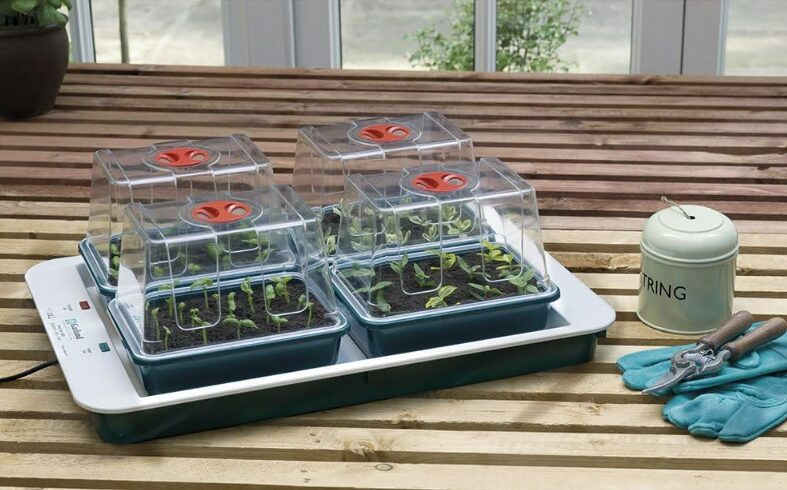
If you want the reliability of thermostat control without committing to a Vitopod, this Garland thermostatically controlled propagator is the most commonly recommended mid-range option. It comes with an adjustable thermostat, has quality, durable construction and a crystal styrene clear cover over each of the four sowing pods.
This propagator is one thats been used by us every year for 15 years to propagate chillies and tomatoes. We typically see around 90% germination success rate, maybe down to 50% for the superhots. That 50% figure for superhots reflects the temperature limitation (manufacturer quotes 19degrees Celcius but I’ve found it heats to around 23C when used indoors) rather than any fault with the propagator.
Significantly better than non-thermostat options for anyone germinating in a conservatory or greenhouse where overnight temperatures fluctuate.
Check current price on Amazon UK →
Premium Option — Vitopod Heated Propagator by Greenhouse Sensation
Best for: Serious chilli growers, superhot varieties, year-round use, those wanting a propagator that doubles as a mini greenhouse
Price: approximately £90-£130 depending on size and configuration
The Vitopod is the propagator that serious UK chilli growers consistently return to, and for good reason. It is widely considered the best heated propagator available to UK home gardeners — the base unit heats evenly across the entire surface with no cold spots at the edges.
Awarded BBC Gardeners’ World ‘Best Buy’ and Grow Your Own magazine ‘Most Innovative Product’, the Vitopod provides precise temperature control for seed starting, cuttings and overwintering plants. The digital thermostat allows 1°C increments between 5°C and 30°C. A soil temperature probe triggers heat supply based on actual soil conditions, ensuring energy efficiency. The base provides even heat distribution, eliminating hot and cold spots.
For chilli growing specifically, three features set the Vitopod apart:
Reaches 30°C accurately — essential for superhot Capsicum chinense varieties. The soil temperature probe means it’s reading actual compost temperature rather than air temperature, so what you set is what you get.
Height extensions: The thing people love about the Vitopod is that you can buy it with double height sides and even an extra layer on top of that, giving enough headroom to take really early chilli plants through to the warmer weather. This means the propagator is useful not just for germination but for growing on seedlings under lights through January and February — you’re not forced to move them out into the cold the moment they sprout.
Built to last — made from recycled, UV-resistant acrylic, this is a propagator built to last years and definitely has a premium feel compared to cheaper options.
The main downside is price. The Vitopod costs 3-4x more than a budget propagator with prices starting at about £140! For a casual grower sowing a few jalapeño seeds in March, it’s overkill. For someone sowing 10-15 varieties of superhot chillies in January who wants to maximise germination rates, it’s the right tool for the job.
Vitopods are not available for sale on Amazon so we would recommend buying directly from Greenhouse Sensations.
Heat Mat — The Alternative Approach
If you want bottom heat without a traditional propagator, a seedling or reptile heat mat is an excellent alternative. Place the mat under your seed tray, cover with a clear propagator lid or cling film.
The advantages are cost and flexibility (a heat mat works with any size of seed tray). The disadvantage is that you need to source a thermometer separately and you ideally need to have a seed tray with a clear lid. included. A heat mat paired with a simple unheated propagator lid achieves very similar results to a budget heated propagator at comparable cost.
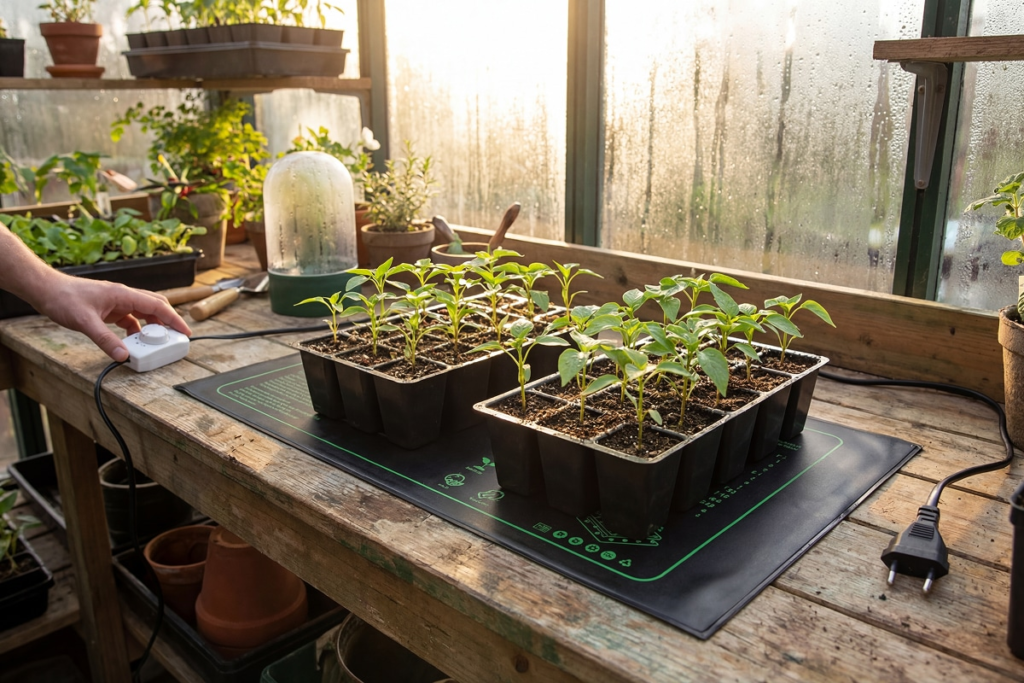
A digital thermometer is essential when using a heat mat. Simply place the probe in the compost rather than at the surface for an accurate reading of what your seeds are actually experiencing.
Check out heat mat prices on Amazon.
How to Get the Most From Your Heated Propagator
Insulate it. Wrap the sides and base with bubble wrap to reduce overnight heat loss — particularly important if your propagator is in a conservatory or greenhouse. Don’t cover the lid as seedlings need light once they’ve germinated. This simple trick can reduce overnight temperature drops by 5°C or more and costs nothing.
Keep vents closed during germination. Seeds don’t need airflow — they need warmth and moisture. Keep the lid vents closed until seedlings appear, then open them gradually to prevent damping off. If you see any signs of mould/fungus on the surface of the compost it means your soil is too moist. If so remove the lid during the day and ensure the vents are open.
Use a thermometer to verify temperature. The temperature displayed on a thermostat may not exactly match the actual compost temperature. A cheap soil thermometer inserted into the compost gives you the ground truth. Aim for 25-28°C for annuums, 28-30°C for chinense varieties.
Place in the warmest room available. Even a thermostatically controlled propagator maintains temperature more efficiently — and more cheaply — in a warm room than a cold one. Our propagator lives in the living room from January to March, much to our family’s amusement.
Move seedlings to light immediately. As soon as shoots appear above the compost surface, move seedlings to maximum light — under grow lights or on the brightest windowsill available. Etiolation (pale, leggy growth) sets in within hours in darkness. See our complete guide to grow lights for chilli plants for advice on keeping seedlings compact and strong.
Once your seedlings are ready to move into the greenhouse, a thermostatically controlled greenhouse heater is the next equipment consideration — see our guide to the best greenhouse heaters for overwintering chillies.
FAQ
Do I need a heated propagator to grow chillies in the UK?
Not necessarily. I grew chillies for several years before investing in a heated propagator. However it can make a significant difference, particularly for early sowing and superhot varieties. Without supplemental heat, UK room temperatures in January and February are usually too cool for reliable germination of Capsicum chinense varieties. A heated propagator also lets you sow weeks earlier than would otherwise be possible, giving plants more time to mature in our short growing season.
What temperature should a propagator be for chilli seeds?
25-28°C for Capsicum annuum varieties (jalapeño, cayenne, Hungarian hot wax). 28-30°C for Capsicum chinense varieties (habanero, scotch bonnet, naga, carolina reaper). Always measure actual compost temperature with a thermometer rather than relying on the propagator’s air temperature indicator. See our chilli germination temperature guide for full variety-by-variety detail.
Is a thermostat worth it on a heated propagator?
For most UK growers germinating in a warm room, a non-thermostat propagator is adequate for annuum varieties. If you’re germinating in a conservatory or greenhouse where overnight temperatures drop, or growing chinense varieties that need consistent 28-30°C, a thermostatically controlled propagator is worth the extra investment.
Can I use a reptile heat mat instead of a propagator?
Yes — reptile heat mats work very well for chilli seed germination. Place the mat under your seed tray, add a clear lid or cover to retain humidity, and monitor compost temperature with a thermometer. This approach is particularly useful if you want to germinate a large number of seeds in a custom-sized setup rather than being limited to a standard propagator tray.
How long do I need to keep chilli seeds in a heated propagator?
Until germination is complete — typically 7-21 days depending on variety and temperature. Once shoots appear above the compost, the seeds have germinated. Move seedlings to a well-lit position immediately and reduce reliance on the propagator for heat, though bottom warmth still helps seedlings develop strong roots in the first few weeks.
Can I leave a heated propagator on all night?
Yes — in fact consistent overnight warmth is one of the key benefits of a heated propagator over an airing cupboard or warm windowsill. Chilli seeds germinate best with consistent 24-hour warmth rather than warm days and cold nights. If your propagator has a thermostat, set it and leave it running continuously.
What size propagator do I need for chilli seeds?
Depends on how many varieties you’re growing. If you grow 5-10 varieties with 3-5 seeds each, you need space for 15-50 individual pots or cells. The Garland Trio with its three cells suits smaller operations well. For larger collections, a full-width propagator or the large Vitopod gives more capacity.