How to Feed Chilli Plants – When, What and How Much
Getting the feeding right is one of the most important things you can do as a chilli grower. Feed at the wrong time, with the wrong product or at the wrong strength and you’ll either starve your plants of nutrients at the point they need them most, or create a salt build-up that causes the exact deficiency symptoms you were trying to prevent. Get it right and the difference in plant health, flower production and ultimately harvest size is dramatic.
This guide covers everything you need to know: when to start feeding, what to use at each stage of the growing season, how much to give, and how to recognise and correct nutrient deficiencies if they appear.
Do Chilli Plants Actually Need Feeding?
The short answer is yes. If you want to maximise your chilli harvest then feeding is a no brainer. This is particularly true for container-grown plants, which is how the majority of UK growers manage their chillies.
Plants growing in the ground have access to a reservoir of nutrients from the surrounding soil that extends far beyond the immediate root zone. Container grown plants are confined to a fixed volume of compost with a finite nutrient supply that depletes over time. Every heavy watering washes some nutrients out through the drainage holes. By midsummer, even a well-prepared initial compost mix will have been significantly depleted.
The signs of nutrient-deficient chilli plants are unmistakeable when you know what to look for. Pale, yellowish foliage, poor growth, low flower production and small fruit. A properly fed plant produces noticeably lusher green growth, more flowers and a heavier crop of pods. After 20 years of growing chillies in the UK, feeding is one of the practices that consistently makes the most visible difference to how our season pans out.
Understanding NPK: What Chilli Plants Need and When
Before getting into specific products it is worth understanding what the ‘NPK’ numbers you will see on the label of most fertilisers actually mean. NPK stands for Nitrogen (N), Phosphorus (P) and Potassium (K) which are the three primary macronutrients plants need in the largest quantities. Each one serves a slightly different purpose for your plants.
Nitrogen (N): Drives leaf and stem growth. High nitrogen levels promote lush, dark green vegetation. Important in the few weeks before flowering starts. Too much nitrogen late in the season encourages growth at the expense of flowering and fruiting.
Phosphorus (P): Supports root development. Important early in the growing season when you want plants to establish a strong root system to support future growth and fruiting.
Potassium (K): Promotes flowering and fruit set. The key nutrient for the production phase. High potassium feeds are what tomato feeds are typically formulated around. This is the reason why tomato feed works reasonably well for chillies.
The chilli plant’s changing nutrient needs
As we have alluded to above the nutrient requirements of a chilli plant change throughout the growing season:
| Stage | What the plant needs | Feed focus |
|---|---|---|
| Seedling (first true leaves) | Very little. Seed compost has enough | Water only |
| Young plant (after first repot) | Balanced growth. Nitrogen and phosphorus | Balanced feed at half strength |
| Vegetative growth (before flowering) | Strong leafy growth. Nitrogen | Balanced or slightly nitrogen-forward feed |
| Flowering and fruit set | Flower production. Potassium | High potassium feed |
| Fruiting | Continued fruit development. Potassium | High potassium feed |
| Late season / overwintering | Wind-down. No feeding required | Water only |
What to Feed Chilli Plants — The Options
Chilli Focus (Our Primary Recommendation)
Chilli Focus by Grow Technology is made from mineral salts and enriched with organic plant acids. It is developed exclusively for chillies and does not contain urea. Amazon UK
Chilli Focus has an NPK ratio of N = 2.98, P = 0.4, K = 3.6. This is the ratio that matters: relatively low phosphorus, balanced nitrogen and potassium. This ratio suits chilli plants throughout the season without driving excessive vegetative growth at the expense of fruiting.
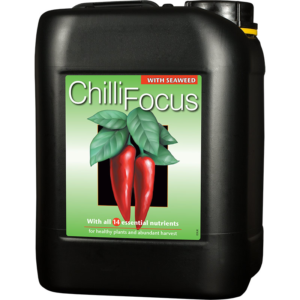
The formula is enriched with a full spectrum of 12 essential micronutrients, including increased levels of magnesium and calcium, which are critical for preventing common issues like blossom end rot and leaf yellowing. It is entirely urea-free, which prevents the buildup of harmful salts in the potting medium, keeping your soil environment healthy and free from root-damaging residues.
The practical advantage over generic feeds is that you don’t need to think about switching products mid-season. Chilli Focus is formulated to work from first feeding through to harvest. We suggest using it at reduced strength for young plants and increase as the season progresses.
If you grow around 10 or 12 different chilli plants a year, the 1 litre version at the recommended dilution should see you through the season. The 1 litre bottle is the best value for anyone growing more than a handful of plants. Chilli Focus is available on Amazon UK
Dosage: Mix 5ml per litre of clean water once a week for young plants or seedlings. Increase dose to 10ml per litre after the onset of flowering.
Tomorite (The Practical Alternative)
Tomorite is a widely available liquid tomato feed made by Levington and sold in most garden centres and supermarkets. Several companies also make their own brands, most of which are the same NPK ratio. It isn’t specifically formulated for chillies but its NPK ratio makes it a reasonable alternative: high in potassium which is exactly what you want during flowering and fruiting.
Tomorite is the most practical option for most growers. It’s cheap, widely available and has an NPK ratio close to what chillies need. We typically use Tomorite as our standard feed throughout the season, applied at half the recommended strength. It’s less precisely matched to chilli requirements than Chilli Focus but the difference in practice is modest for container growing in good compost. If you already have Tomorite in the shed it works perfectly well. Buy now on Amazon.
Note: Tomorite has a higher nitrogen content than Chilli Focus. This is fine through the vegetative growth stage but if you notice very lush leafy growth with few flowers in July, switching to a lower-nitrogen feed or diluting more heavily can help redirect the plant’s energy toward fruit production. For harder to grow super hots we tend to use chilli Focus and Tomorite for anything else.
Seaweed Feed (The Early Season Supplement)
A dilute liquid seaweed feed applied every 2-3 weeks from early spring is an excellent complement to your main feed regime. Seaweed is not a significant source of NPK nutrients but provides a broad spectrum of trace elements such as iron, manganese, zinc, boron, copper. These minerals are not always present in other liquid feeds.
Overwintered plants can be given a weak dose of liquid seaweed feed at alternate waterings (roughly every 10-14 days) to keep them ticking over before switching to Chilli Focus from March onwards.
Maxicrop liquid seaweed is our preferred choice and is widely available.
Epsom Salts (For Magnesium Deficiency)
Epsom salts (magnesium sulphate) are not a general fertiliser but are genuinely useful for correcting magnesium deficiency specifically. The tell-tale sign of magnesium deficiency is interveinal yellowing on older leaves. This means that the veins remain dark green while the leaf tissue between them yellows. It’s distinct from nitrogen deficiency (uniform pale yellowing) and iron deficiency (yellowing on new growth rather than old).
If you need to correct a deficiency, a foliar spray of magnesium sulfate works quickly. About one teaspoon of epsom salts per litre of water, every two to three weeks. Only spray when you can see signs of deficiency. Healthy green leaves don’t need it.
See our guide to yellow leaves on chilli plants for a comprehensive visual guide to identifying different deficiency symptoms.
Slow-Release Granular Fertiliser — For the Final Pot
Adding a slow-release granular fertiliser such as Osmocote to the compost when potting into the final container provides a nutritional baseline for the first 6-8 weeks. This isn’t a substitute for regular liquid feeding but provides a useful buffer and means the plants are getting a steady low-level supply of nutrients even in the weeks between liquid feeds. We add a handful to the compost when potting on into the final pot each spring. See our guide to the best potting medium for chilli plants for the full potting mix approach.
When to Feed Chilli Plants – A Month by Month Guide
January to March: Water Only for Seedlings
Freshly germinated chilli seedlings do not generally need feeding. A good quality seed compost contains enough nutrients to sustain seedlings through their first few weeks. Applying fertiliser to very young seedlings can cause root burn and damage the delicate root system stunting future growth.
Water only until seedlings have been potted on into their first ‘proper’ pot with compost. We would define that typically from the 3-inch (8-10cm pot) stage onward.
The exception is overwintered plants waking from dormancy in late February-March. These will benefit from a very dilute seaweed feed (half the recommended strength) as they show new growth to encourage the resumption of active growth. See our full overwintering guide for full spring recovery advice.
April: Begin Feeding After First Repot
Once seedlings have been potted on from their initial module or small pot into a larger container with fresh compost, they’re ready for their first feed. Start conservatively. We wont do more than half the recommended strength of your chosen liquid feed, applied once per week on a watering day.
This is the stage where Chilli Focus earns its keep most clearly. The balanced NPK at low strength supports good root establishment and steady growth without pushing excessive vegetative growth.
May — June: Increase to Full Strength
As plants enter active growth in warmer conditions, increase feeding to the full recommended strength. By this point plants should be in their final pot or close to it, growing vigorously and — for fast-maturing varieties — beginning to show flower buds.
As plants begin to flower, it’s important to prevent a nutrient salt build-up which can cause root rot or nutrient lockout where roots stop absorbing nutrients. On a warm, sunny day, gently flush the top of the soil with clean, prepared water. This allows the water to dissolve salts and carry them down to the roots for reuse. Do this approximately once a month. Chilligrowingguide
July to September: High Potassium Through Fruiting
Once plants are in full flower and beginning to set fruit, potassium becomes the most important nutrient. Switch to a high-potassium feed or continue with Chilli Focus which maintains good potassium levels throughout.
Continue feeding weekly watering in between as and when required depending on temperatures. Never feed every time you water, as it leads to salt build-up and causes the deficiencies you’re trying to prevent.
This is typically your most productive period and maintaining consistent feeding through July to September usually has the biggest impact on fruit size and yield.
October onward: Reduce and Stop
As temperatures drop and day length shortens, growth and ripening slows and nutrient requirements drop significantly. Reduce feeding frequency from weekly to fortnightly in to October, then stop entirely as plants enter dormancy.
When you are about ready to take the final pods off the plant and complete your harvest, drop down to only water. This allows the plant to use up all the nutrients remaining in the compost.
Likewise for plants being overwintered, stop feeding completely through the dormant winter period. Resume with weak seaweed feed when new growth appears in late February or March.
How to Feed Chilli Plants
Always water before feeding. Never apply concentrated or diluted liquid fertiliser to bone-dry compost. It is best to apply to compost that is already slightly moist. Applying feed to dry compost concentrates salts at the surface rather than distributing them through the root zone. We like to give our plants a light watering in the morning then feed them in the evening on a feeding day.
Dilute correctly. More isn’t better with liquid feeds. The salt concentrations in mineral fertilisers are precisely calibrated. Doubling the dose doesn’t double the benefit, it risks root burn which can damage or kill your plants. It is best to start at half strength and build up gradually over the first few weeks of feeding to reduce the chances of plant shock.
Apply at the right time of day. Feed in the morning or evening on a day when temperatures are moderate. Avoid scorching afternoons when the compost surface dries rapidly, potentially concentrating salts.
Flush monthly. Once a month, water generously with plain water until it runs freely from the drainage holes. This will help flush accumulated salt deposits from the compost and prevents build-up that can block nutrient uptake. Aim to do this on a warm day so the surface dries quickly.
Watch the plants. The best guide to whether your feeding regime is working is how the plants look. Dark green, vigorous growth with good flower production means your feeding is on track. Pale leaves, poor growth or excessive leaf growth with few flowers are signals to adjust.
Signs of Overfeeding
Overfeeding is as problematic as underfeeding and often produces counterintuitive symptoms that look like deficiency rather than excess.
White crust on compost surface. This is a reliable sign of salt accumulation from over-concentrated feeding. Reduce feed strength and flush with plain water.
Leaf tip burn. Browning at the tips of leaves, sometimes curling inward. Characteristic of fertiliser burn from excessive salt concentration.
Nutrient lockout. Plants showing deficiency symptoms despite regular feeding. Salt build-up changes the chemistry of the compost and prevents roots absorbing nutrients even when they’re present. Repot into fresh compost or flush thoroughly with plain water.
Very lush growth with poor fruiting. Typically caused by excessive nitrogen encouraging vegetative growth at the expense of reproduction. Switch to a lower-nitrogen, higher-potassium feed and reduce application strength.
Signs of Underfeeding
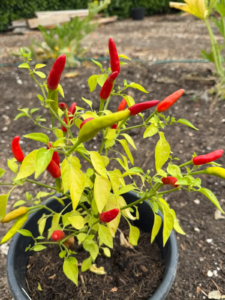
Pale, yellowish foliage overall. Uniform pale green or yellowing across the plant typically indicates nitrogen deficiency. The plant hasn’t enough nitrogen to maintain chlorophyll production in its leaves. See image to the right.
Poor growth despite adequate watering and light. If a plant isn’t growing in conditions where it should be, nutrients are often the limiting factor.
Small fruit, low yield Insufficient potassium during the fruiting phase limits fruit development.
Interveinal yellowing on older leaves Magnesium deficiency specifically. Treat with an Epsom salts foliar spray (1 teaspoon per litre) applied every 2-3 weeks until symptoms resolve. See our yellow leaves guide for full diagnosis guidance.
Feeding Chilli Plants: Quick Reference Summary
| When | What | How much | How often |
|---|---|---|---|
| Seedlings in seed compost | Nothing | — | — |
| After first repot (April) | Chilli Focus or Tomorite at half strength | 5ml per 2 litres | Weekly |
| Active growth (May-June) | Chilli Focus or Tomorite at full strength | 5-10ml per litre | Weekly |
| Flowering and fruiting (July-Sept) | High potassium — Chilli Focus full strength | 10ml per litre | Weekly, alternating with plain water |
| Late season (October) | Reduce to plain water | — | Fortnightly then stop |
| Overwintered plants (Nov-Feb) | Nothing | — | — |
| Overwintered plants resuming (Feb-March) | Weak seaweed | Half strength | Every 2 weeks |
FAQ
When should I start feeding chilli plants?
Start feeding after the first repot from seed compost into a larger pot — typically from 3-4 weeks after germination when the seedling is established in fresh compost. Don’t feed seedlings in their initial seed compost as this has sufficient nutrients for the early stage. Begin at half the recommended strength and build up gradually.
Is Chilli Focus better than Tomorite for chilli plants?
Chilli Focus is specifically formulated for chilli and pepper plants and is our preferred choice. Its NPK ratio is precisely calibrated for capsicums and it contains a full spectrum of micronutrients. Tomorite works well and is more widely available and cheaper. The practical difference for most container growers is modest. If you have Tomorite already, use it at half strength. If you’re buying specifically for chillies, Chilli Focus is worth the premium.
How often should I feed chilli plants?
Weekly liquid feeding through the main growing season (April-September) is the standard approach. Alternate liquid feed and plain water (one watering with diluted feed, the next with plain water) rather than feeding at every watering. This prevents salt accumulation while maintaining consistent nutrient availability.
Can I overfeed chilli plants?
Yes. Overfeeding can cause root burn, salt accumulation and nutrient lockout. Symptoms of overfeeding include white crust on the compost surface, leaf tip burn and (counterintuitively) deficiency symptoms. Always start at half the recommended strength and build up gradually. If in doubt, less is more.
Should I feed chilli plants during flowering?
Yes. Feeding continues through the flowering stage and is particularly important during fruit set. Switch to or maintain a high-potassium feed during flowering to support fruit production. The one adjustment is to alternate more strictly with plain water to prevent salt accumulation during this sensitive stage.
Why are my chilli plants still yellow despite regular feeding?
Yellow leaves despite feeding suggests either a specific deficiency (magnesium is most common in container growing), nutrient lockout from salt accumulation, or pH issues preventing nutrient uptake. See our complete guide to yellow leaves on chilli plants for a detailed diagnostic guide covering every cause.
Should I feed chilli plants during overwintering?
No. Stop feeding completely when plants enter dormancy in October-November. Dormant plants have very low nutrient requirements and feeding during this period risks root damage when the plant can’t process nutrients effectively. Resume with a weak seaweed feed when new growth appears in late winter. See our overwintering guide for full dormancy management advice.
Can I use the same feed for seedlings and mature plants?
The same product can be used throughout the season. Adjust the strength rather than switching products. Start at half strength for young plants and seedlings after their first repot, increase to full strength once plants are established and in active growth.