
Best Potting Compost for Chilli Plants – Our Potting Mix Recipe
When buying regular potting compost the first decision you’ll face is whether to opt for peat free or not. Peat free has traditionally been the best kind however it is particularly bad for the environment as it is harvested from the natural environment, usually from areas with fragile and diverse eco-systems.
While there are some ethically sourced peat based mediums out there they are usually flown halfway around the world (places like Canada) so if you’re concerned for the environment, it’s probably best to opt of a peat free compost.
The good news however is that there are now a good selection of peat free composts available at virtually all garden centers. While these have had a bit of a bad reputation in the past they have improved massively in recent years.
Peat composts is very good at retaining moisture where as in my experience peat free composts tend to dry out very quickly. As a result when using peat free you may want to add additional ingredients to adjust the water retention of you potting medium:
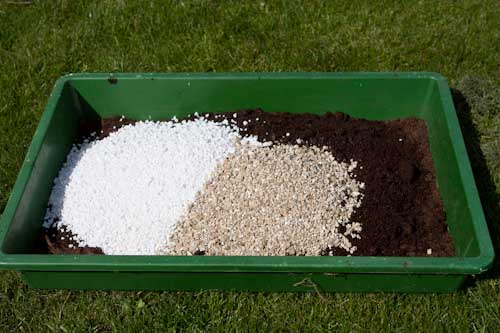
Vermiculite
This is a natural mineral that has been heated to expand it out into its very light weight form. It’s main attraction is it’s ability to hold on to moisture and slowly release it and the nutrients into into the surrounding soil over a period of time.
A common problem with plants grown in pots is that daily watering can wash out many of the nutrients from the compost. Vermiculite mixed into the compost will help avoid this problem, particularly if you’re using peat free compost which can suffer from poor water retention. I usually get through 1 bag per year and in my opinion it is well worth considering the relatively cheap price on Amazon.
Perlite
It is a great drainage aid to compost, ensuring that roots do not get rotten by sitting in excessively wet compost, which can be very useful if you’re using a peat based compost. I also finds that perlite helps prevent the root ball from becoming too compacted later on in the growing season.
Well Rotted Manure
Well rotted manure can be used as a substitute for peat in compost. Not only does it add a huge boost of nutrients to the mix but it also adds structure and water retaining properties to a peat free medium. Just be sure it is very well rotted before using it in order to avoid ‘scorching’ the plants roots.
The Best Chilli Growing Medium
As i stated above everyone has their own preferences however i usually opt for a mix as follows:
- 70% Peat free multi purpose compost
- 10% Vermiculite
- 10% Perlite
- 10% Well rotted horse manure
I don’t get too fussy about quantities of each and usually work be feel.
Moisture Levels
Potting into a dry mix and then giving the potted plant/seeds ‘a good soak’ can cause the compost to become too compacted as the large volume of water rushes through the pot, often taking the seeds down deeper then you want or stealing away nutrients from the roots.
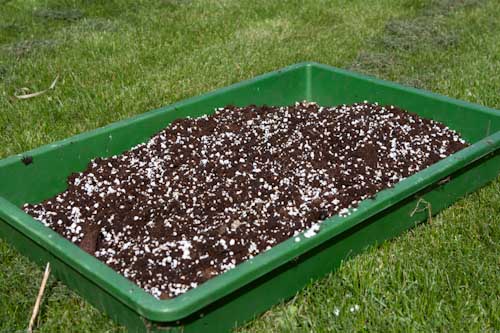
When either planting seeds or potting on young plants i find it beneficial to prepare (and water) my potting medium a little bit in advance. If i feel the compost is a little dry I usually make my mix up in a bucket (using the quantities above) then water with a watering can fitted with a rose and mix well. I’ll then usually leave it 10 minutes for the moisture to work through and mix again before potting.
What About Coffee Grounds?
Mark in our comments asks whether coffee grounds are useful. Yes, we compost all our coffee grounds. Used coffee grounds are slightly acidic (pH 6-6.5), add nitrogen to the mix and improve drainage. They’re not a substitute for the main components above but are a worthwhile addition if you have them available. Don’t add them fresh in large quantities — composted or mixed in small proportions works best.
If you make your own compost, see our guide to composting with a dalek composter for how to produce consistent, high-quality homemade compost for your potting mix.
FAQ
What is the best compost for chilli plants?
A peat-free multi-purpose compost mixed with 10% perlite and 10% vermiculite is our standard recommendation for most UK chilli growers. Adding 10% well rotted manure improves nutrient content and structure. This gives good drainage, adequate moisture retention and the nutritional foundation plants need for a productive season.
Can I use regular garden soil for chilli plants in pots?
No — regular garden soil is not suitable for container-grown chillies. It compacts in pots, has poor drainage and often carries pathogens and weed seeds. Always use a proprietary compost mix as your base.
Should I use the same compost for chilli seeds as for established plants?
No. Seeds should be germinated in a fine seed compost rather than standard multi-purpose. Seed compost has a finer texture and lower nutrients that suit germinating seeds. Pot on into a standard mix once seedlings are established. See our germination guide for more detail.
Is peat free compost as good as peat for chillies?
Yes. Modern peat-free composts have improved significantly and perform comparably to peat for chilli growing when mixed with perlite and vermiculite to improve drainage and moisture retention. The environmental benefits of peat-free make it the clear choice regardless
Can I replace vermiculite with perlite or vice versa?
Yes. You can use 20% perlite instead of 10% perlite and 10% vermiculite as Ruth in our comments confirmed. Pure perlite is better for drainage, pure vermiculite is better for moisture retention. Our mix uses both because chillies need good drainage and reasonable moisture retention simultaneously.
Can I use John Innes compost for chilli plants?
John Innes No. 2 or No. 3 can be used but tend to be heavier and denser than peat-free multi-purpose. If using John Innes increase the perlite proportion to 20% to compensate for the denser texture. Avoid John Innes No. 1 — it’s too low in nutrients for established plants.
When should I start feeding chilli plants in pots?
If you’ve included manure or slow-release granules in your potting mix, plants have a nutritional baseline for the first 6-8 weeks. Start liquid feeding with a balanced fertiliser at half strength once plants are flowering. See our guide to feeding chilli plants for a complete schedule.
Do chilli plants need ericaceous compost?
No. Chillies prefer a slightly acidic to neutral pH (6.0-7.0) which most peat-free multi-purpose composts naturally provide. Full ericaceous compost (pH 4.5-5.5) is too acidic for chillies and would inhibit nutrient uptake.

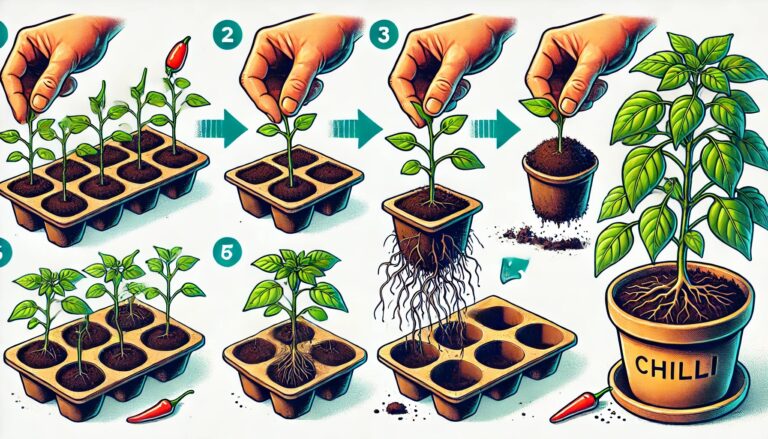
Just thinking! I normally plant my chilli seedlings directly into the garden and they grow well. I am wondering why you have to re-pot gradually up to the 10″ or 12″ size. The plants in the garden have far more space for roots to travel than if you planted directly into the 12″ pot. As my location has changed, I am needing to plant into pots now so read this article with interest.
Also, another question, do you make up a soil mix using buffered coconut coir? If so, do you find using it fresh without composting it still gets good results mixing it with vermiculite/perlite and well rotted manure?
hi CK do you ever use coffee grinds in your compost .
Yes i always cmpost my coffee grounds.
Can I use 20% perlite instead of 10% vermiculite and 10% perlite?
Absolutely. 20% perlite would make a great potting medium for yur peppers.
Hi. Can I replace the 10% well rotted horse manure with 10% fish blood and bone mix?
Yes you can Patrick!
Excellent article. I will be facing some of these issues as well..
Your site made reading interesting and simple, never having grown Chillies from seed this is my first venture, propagator is a ventilated shoe box with a lid from a high street store, internal growing
area cake dividers with holes, and seed soil. A bag of 20 MURGANO SCORPION seed and Bonnet seed from a high street store ( 3 for 0.80p), total investment just under £20.00….and I have 16 Murgano seedlings.
Extra light comes from a diy super bright Led unit, 30 Blue and 10 Red, running of a laptop psu.
Dave C,
Welcome to the wonderful world of growing chillies! As usually semi DIY approach tend to do best and are a lot more fun than buying all of the gear straight away! Good luck!
Thanks a lot! I made a really tiny variation to your mix, as I am growing indoor, so it is:
80% Peat free Multipurpose Compost
10% Vermiculite
10% Perlite
Here is my germinated seeds: http://www.youtube.com/watch?v=mbwUUz9-MgM
Thanks a lot for your useful suggestions!
What grade of Vermiculite should i use or doesn’t it matter?
It doesn’t really matter. I usually just grab what looks good at the garden center!
can i still use the percentages of soil, perlite and vermiculite without the manure? i.e 80% peat free, 10% perlite and 10% vermitculite
Louis – Yes, that’d be fine!