
Does Pot Size Matter for Chilli Plants? Our Experiment Results
We’ve had a lot of questions from readers about if and when they should pot on their chilli plants and what pot sizes to use. This is a hard question to answer as much will depend on the stage of development of your plants and the condition they are grown in.
Many of our readers seem to be planting their chilli seeds in communal containers such as window boxes or large planters. While this is great for saving space during the germination and seedling stages it can cause problems later on. If left too long, the plants roots become entangled and when the plants need separating into larger pots you can run the risk of damaging plants. As a result planting chillies in single pots is best.
As I mention in my recent post about potting on I tend to pot my plants on every few weeks when the roots become visible out of the bottom of the pot. During a season i usually pot on about 4 times, gradually increasing the pot size up to about a maximum of 10-12″ depending on the variety.
Potting On Experiment
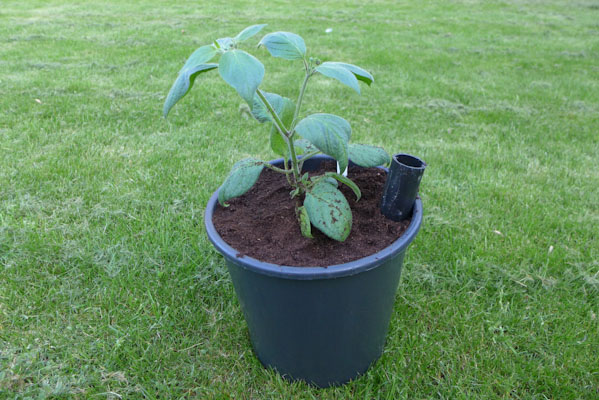
While the above potting on routine seems to have worked for me in the past, I’m not too sure if something else would work better to I’ve decided to run a little experiment. I have taken 6 Cayenne plants, all the same size (roughly 15″ in height) that until now have been in 6″ pots. I will leave two in the same pots and have potted two into 8″ pots and two into 10″ pots and see how they fair in different pots.
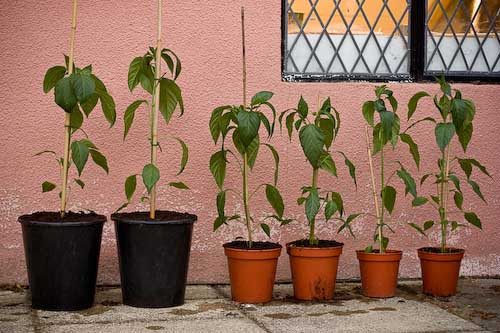
I’ve heard one theory that states that potting into too large pots means the plant wastes energy developing it’s root system instead of flowering and producing chillies. Conversely other wisdom states that leaving in too small pots won’t allow the plant space to develop and produce to it’s full potential.
All of the plants are the same size at the minute and none are flowering quite yet so I think now is the perfect time to run this test.
I’ll keep all six plants in the same conditions (in a conservatory that receives a good amount of light and has a small heater for chilly nights) and see how their growth is affected by their pot size. Of course not only with the rate of growth be interesting but the yield of Cayenne peppers I get form them. I’ll report back later in the season with the results!
Do you have any tips or interesting ideas about pot sizes for peppers? If so leave a comment below.
The Experiment Results
After running this experiment across a full growing season the results were clear — and somewhat counterintuitive.
The plants in the 6-inch pots — the ones left in their original containers — produced the highest number of chillies per plant. The plants in the larger pots grew bigger and bushier but put more energy into vegetative growth and produced fruit later and in lower quantities per plant.
This mirrors exactly what Julie found independently in the comments section – her plants in smaller pots produced more chillies per plant and the chillies themselves were larger, while the plants in bigger pots grew larger but set less fruit.
The explanation seems to be that when a chilli plant is slightly root-bound (not dangerously so, but with its roots filling the available space) it perceives a degree of stress that triggers earlier and more prolific flowering. A plant with unlimited root space has less incentive to reproduce and instead puts energy into vegetative growth.
This doesn’t mean you should leave plants in tiny pots indefinitely — a severely root-bound plant will eventually suffer from nutrient depletion and water stress (often resulting in yellowing of the leaves). But it does suggest that the common advice to always pot up into the largest pot available isn’t necessarily right for chilli growing specifically.
Our revised recommendation based on the experiment and reader experience:
- Pot on regularly in small increments – do not jump from a 3-inch pot straight to a 12-inch pot
- Move up one pot size at a time, waiting until roots appear from the drainage holes
- For most varieties, a final pot of 7-10 litres (approximately 10-12 inches) is ideal
- For large varieties like Rocoto or giant bell pepper types, go up to 12-15 litres
- For compact varieties like Apache or Prairie Fire, a final pot of 3-5 litres is sufficient
- Feed regularly with a specialist chilli fertiliser from the point of first flowering – Chilli Focus is our recommendation and what Mike in our comments has used with excellent results
What Pot Size Should I Use for Chilli Plants?
Based on 20 years of growing and the feedback of hundreds of readers, here’s the pot size guide we’d recommend for most UK growers:
Seedling Stage — Module Trays or 3-inch Pots
Once your seeds have germinated and you have a seedling with its first true leaves, pot on into individual 3-inch (7-8cm) pots. Don’t be tempted to go bigger at this stage — a large volume of compost around a small root ball stays wet for too long and can cause damping off. See our guide to when to repot chilli seedlings for exactly what to look for before making this first move.
Growing On — 5-inch Pots
When roots appear from the bottom of the 3-inch pot — typically 3-4 weeks later — pot on into a 5-inch (12cm) pot. Again, just one size up.
Intermediate Stage — 7-inch / 1-2 Litre Pots
A further 3-4 weeks later, once the roots fill the 5-inch pot, move into a 7-inch or 1-2 litre pot. Plants at this stage are usually 15-25cm tall and growing vigorously.
Final Pot — 7-10 Litres for Most Varieties
Most chilli varieties will spend the bulk of their productive season in a final pot of 7-10 litres — roughly a 10-12 inch pot. Based on our experiment and reader experience, going bigger than this tends to produce lush growth at the expense of fruiting. This is the stage where feeding becomes critical — use Chilli Focus or liquid tomato feed at half strength weekly once flowering begins. See our guide to feeding chilli plants for exact timings and quantities
Which Pot Material?
Plastic pots — the standard choice for most growers. Lightweight, cheap and retain moisture well. The main disadvantage is that plastic pots in a greenhouse in summer can get very hot, which can stress roots.
Terracotta — heavy and expensive but genuinely good for chillies and they look great. The porous walls allow excellent airflow around roots and regulate moisture well. Our choice for overwintered plants kept indoors.
Grow bags — the flat compost-filled bags work well for chillies and are popular with greenhouse growers who want to plant multiple plants in a row. The limited depth restricts root development somewhat but the large compost volume compensates. Useful if you’re growing in a greenhouse border.
For the full picture of growing chillies from seed to harvest see our complete growing guide.
FAQ
Does pot size affect chilli yield?
Yes. Based on our experiment and reader experience, chilli plants in smaller pots tend to produce more fruit per plant while plants in larger pots produce more vegetative growth. The reason appears to be that slight root restriction triggers the plant to focus on reproduction. That said, severely root-bound plants suffer from nutrient depletion and water stress. The ideal is a pot that’s appropriately sized for the plant — neither too small nor too large.
When should I pot on my chilli plants?
Pot on when roots become visible from the drainage holes at the bottom of the pot, or when the plant seems to stall in growth despite adequate watering and feeding. During a typical UK growing season most plants are potted on 3-4 times — from module tray to 3-inch, 3-inch to 5-inch, 5-inch to 7-inch, and 7-inch to final pot.
What is the best final pot size for chilli plants?
For most chilli varieties a final pot of 7-10 litres (roughly 10-12 inches) gives the best balance of root space and fruit production. Compact varieties like Apache do well in 3-5 litres. Large varieties like Rocoto benefit from 12-15 litres or growing in the ground if conditions allow.
What happens if I pot into too large a pot too quickly?
The plant tends to focus energy on root development and vegetative growth rather than flowering and fruiting. A large volume of compost also stays wet for longer, which can cause root stress in cool conditions. Always pot on gradually — one size at a time — rather than jumping straight to a large final container.
When is it too late to pot on chilli plants?
Once a plant has set significant amounts of fruit — typically from July onwards in the UK — repotting causes unnecessary stress and can trigger flower and fruit drop. If a plant is still in a small pot by midsummer, leave it in place and compensate with more frequent feeding and watering rather than disturbing the roots. Repotting too late in the season can cause chilli flower drop.
Hi everyone. This really is an interesting site. I am passionate about growing chillies, but have a lot to learn. I found that a chilli in a smaller pot produced more fruit, whereas a chilli in a larger pot grew huge with little fruit. I was thinking that the energy was going into the plant, rather than the root system, but your ideas about the root system make sense. My house is not too warm, so I have a bit of a problem overwintering. Has anyone got any tips?
Shauna – Treat them mean! To over winter the plants don’t need much heat at all – so long as they are safe from frost or freezing temperatures. If they are in your house they should be plenty warm enough.
i read with interest about the “planting on” I have had a life long interest in Chillis and decided I would try and make some money growing I live in the south of Spain and so have an Ideal climate for chillis, the problem has been the soil as it is very heavy and does not drain very well, So I decided i would plant some in the ground having mulched heavily and some along side in pots, having raised about a thousand plants from seed in plugs I found that the plugs came to a point where they stopped growing after inspecting the root system I did not find them pot bound, I immediatly planted some up into 3 inch pots, and they out grew the plugs within a week I had a noticable difference, I agree with keds comments of last year, This was due to fresh nutrients in the compost, Based on this I was planning to continue potting on regularly but having read the chilli Kings comments I will try to get up to about 8 to 10 inch potts and increase the feeding as fot the ones I have in the ground i would be interested in any experience people have had regarding the life cycle of thier plants, Great forum hope it keeps going. Cheers,
For many years I have grown chillis of many varieties. Naga being my favourite, but long sweet varieties also.
My wife and I have been to Turkey on many holidays, and whilst travelling from the airport to our favourite hotel we passed a huge chilli farm. The plants always seemed the same, year on year. Planted in the ground, and the size of a small bush, about a meter tall.
So it might appear that chilli plants can live for quite a long time in warm, frost free climates.
However, to keep the plants flourishing they need nutrients and food, the best I have ever used is a liquid food called Chilli Focus, it increased my yeald two fold.
Also seaweed put through a liquidiser and introduced into the soil can have amazing results.
Happy growing.
I think we are all excited to hear an update. I’ve been potting on as well but the weather has been holding me back badly in Belfast so the results to date are poor.
Hi
Found this site on a search engine and have really enjoyed reading through your articles. I’m growing a few different types of Chillies in my conservatory this year and I ended up with far more plants from seed than I was expecting…I didn’t expect such a high success rate! I decided to repot the best couple of each types into large pots but couldn’t bare to destroy the plants which I couldn’t rehome so left them in there smaller pots. Now i’ve found the plants in the large pots are more bigger but those in the small ones have far more Chillies per plant and the Chillies are bigger….
I was wondering if the larger plants will catch up or whether they’ve put too much of their energy into their roots? Should I now re-pot the smaller ones or will it be too much of a shock now they’ve got lots of fruit?
Thanks
Julie
July – Glad you enjoy the site! I to have found that the smaller pots have produced a higher yields. I wouldn’t bother re-potting now, just accept the lower yields and mark it down as a lesson learned for next year!
Its been about 6/7 weeks now since you re-potted your cayennes into different size pots, whats the results?, which is looking the tallest?Great experiment!
I’ve found that since germination I’ve ended up potting on about every 6 weeks, which is when the roots start to poke out of the bottom of whichever pot they are in. This goes for both the chinense and annums I’ve got on the go.
Since February my chillis have gone from:
1) Individual pods in a 40 pod seed tray
2) 6 inch pots
3) 9 inch (5 litre) pots
4) 12 inch (10 litre) pots
I have a Dorset naga that has torn ahead and I’ve just repotted it in to a 20 Litre pot that I got from a local hydroponics shop as an experiment. In the past week it has accellerated even further!
I’m finding that after each repotting, the chillis go through a marked growth spurt. I put this down to a combo of extra root space and fresh nutrients in the new compost.
I’ve left some chillis behind in smaller pots and after just 1 week, the repotted chillis have rapidly outpaced them.
I’ve been feeding them with a foliar spray of Wilkinsons organic seaweed extract and they have responded well to this. I just got my hands on some Chilli Focus and I’m going to be using that from now on.
@ Baron – Home grown hot sauce is my aim too, I’ve got all kinds of herbs, tomatoes, corgette aubergine etc that are going to go in to a 100% garden grown concoction 🙂
its all about the heat and the feeding u need at least 25 c 2 get a good chilli i have over 5o chilli plants on the go usualy as well as lots of other veg mosly in green houses and in well treated soil iv grown some realy hot birds eye chillies that amazed me and sum good nargra but these r very difficult 2 grow from seed but it is good fun as r cuccumbers its allabout making a good hot sauce having grown everything that goes in it good luck
I have done the same with a different chillie but also put some outside some inside and one in a pot full of grow bag soil
we will see!!!!
Gazza – Great, be sure to let us know how you get on!