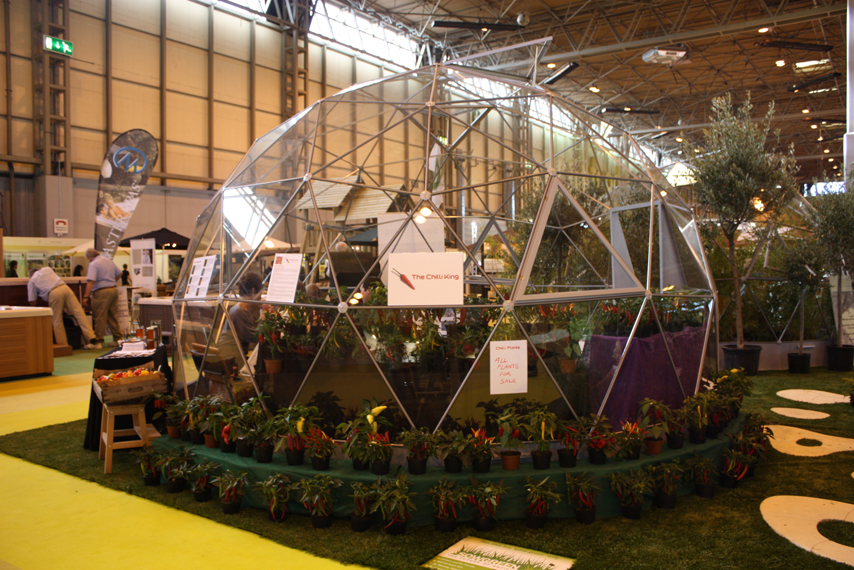
A big thank you to all those of us that came to see The Chilli King stand at the Grand Designs Live show. It was great to put a face to many of the names we’ve seen in emails over the last few month.
What surprised us most about the show was the huge interest that exists in growing chillies, even at a non horticultural show like Grand Designs Live. It seemed that the vast majority of people we spoke to had tried to grow their own hot peppers at some point in the last couple of years. Despite not being the best year weather-wise here in the UK to grow chillies it was great to hear that so many of you had had a successful crop.
And of course for those that haven’t done so well this year it was good to hear that on the whole you’re determined to not give up and try again next year! If you purchased some of our seeds be sure to check out our articles on growing chillies.
We’d like to thank SolarDome for allowing us to share one of their fabulous glass domes at the show. If you were watching TV in the eighties/nineties yes this is the same company that made the infamous Crystal Maze domes, the only difference being this one wasn’t filled with gold and silver tokens but chillies!
[ad name=”square”]
If you have been inspired by our site to start growing your own chillies then you should come down to the National Exhibition Center (NEC) at Birmingham between Friday the 10th & Sunday the 12th of October 2008. We have been invited to exhibit at the Grand Designs Live exhibition hosted by non other than the Grand Designs presenter [continue reading…]
If you ask anyone why chilli peppers are hot you will usually be greeted with a long pause and a scratch of the head. Having hot fruit, and seeds in particular is rather counter intuitive from a evolutionary perspective.

It is generally accepted that plants produce nice tasty colorful fruit to attract and encourage animals to eat them and spread their seeds allowing the plant species to spread. So why then do chillie plants encase their seeds in capsaicin (the chemical that produces the heat in peppers) that will put off all but the most determined or hungry of animals?
Well researches from the National Academy of Sciences think they have finally solved the mystery.
Firstly it should be noted that the various species of chillie plants out there have been able to survive and spread thanks to the inability of most species of birds to detect the heat present in capsaicin. Secondly it seems that capsaicin is produced to help plants prevent the fungus Fusarium. Fusarium is the biggest cause of seed mortality in the wild and therfore the heat produced by chili plants is simple their evolutionary way to protect their seeds.
[ad name=”square”]